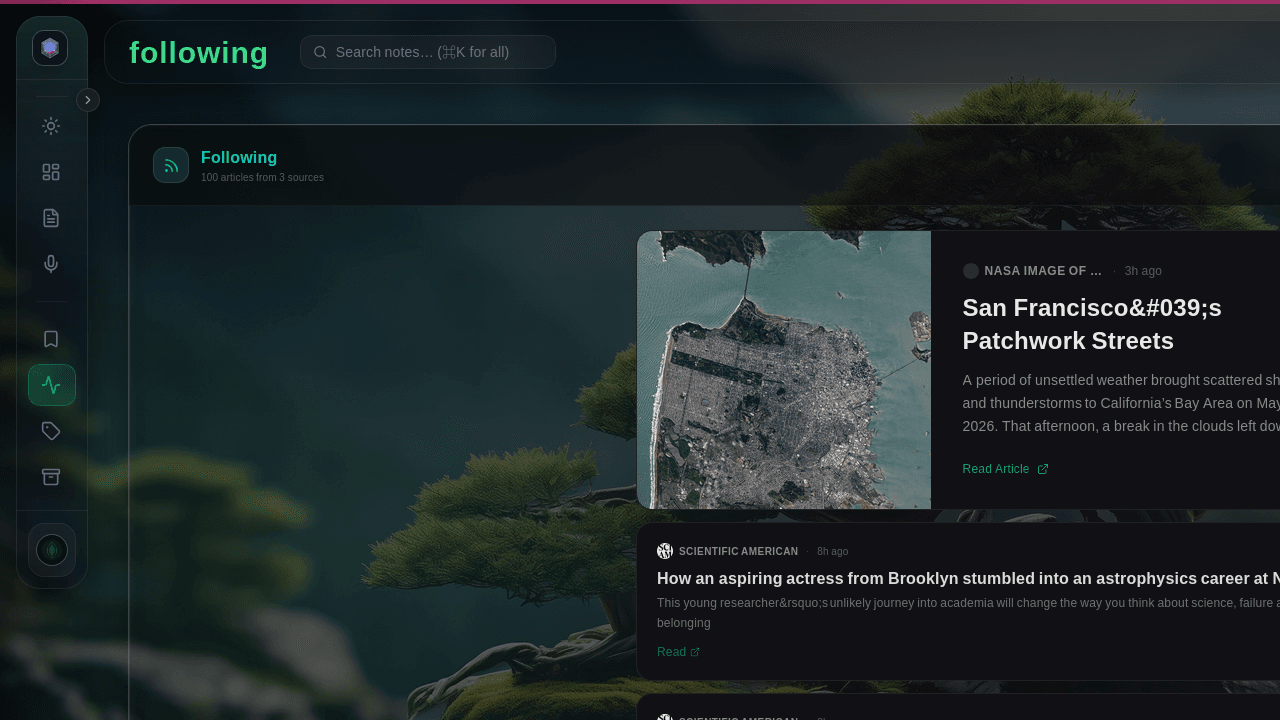
Manual capture is powerful, but it requires you to remember to do it. RSS is the opposite — it captures automatically, but you have no control over what comes in. Glassy supports both. Your RSS feeds and your manual captures (browser extension, voice, Obsidian sync) feed into the same indexed corpus, searchable by hybrid search and queryable via MCP.
The capture spectrum
Glassy's research capture loop supports multiple capture methods, each at a different point on the automation spectrum:
- Browser extension — Manual, intentional. You choose what to capture. High signal, low volume.
- Voice Studio — Manual, spontaneous. You record when ideas strike. See the Whisper pipeline.
- Obsidian sync — Automatic, curated. Your existing vault flows in. See sync guide.
- RSS feeds — Automatic, subscription-based. Content arrives without any action from you. High volume, variable signal.
Why RSS still matters in 2026
RSS was declared dead a decade ago. It was not. RSS is the only open, decentralized content distribution protocol that has no algorithm, no ads, and no platform lock-in. You subscribe to feeds, you get content. No recommendation engine decides what you see. No platform throttles your reach.
For knowledge workers, RSS is how you keep up with research blogs, industry news, open-source release notes, and thought leaders — without scrolling through a social feed. When Glassy indexes your RSS content, every article from every feed becomes searchable by meaning, not just by title.
How it works in Glassy
- Subscribe — Add RSS feed URLs in Glassy's settings. Glassy polls feeds on a schedule (typically every 30-60 minutes).
- Fetch — New items are fetched and converted to Markdown with frontmatter (title, link, published date, author, feed name).
- Index — Each item is indexed with hybrid search — BM25 for keywords, vector embeddings via mxbai/MiniLM for semantic matching.
- Query — Ask Claude, Cursor, Windsurf, OpenCode, Hermes, Openclaw, Pi, or any MCP-compatible AI agent about your RSS content. "What did Hacker News say about WebGPU last month?" returns results from your indexed feeds.
- Cite — Every result includes the source URL, so you can trace claims back to the original article.
Signal vs noise
The risk with RSS is volume. A single feed can produce 50 articles per week. Ten feeds produce 500. Glassy's hybrid search solves the discovery problem — you do not need to read everything. You query when you need information, and the search returns the most relevant items across all feeds. The unread backlog becomes a searchable archive, not a guilt-inducing inbox.
This connects to our broader philosophy about streak-free design — your knowledge base does not shame you for not reading. It is ready when you are.
Recommended feeds for knowledge workers
- Hacker News — Technology, startups, research. High volume, high signal.
- arXiv (cs.AI, cs.CL) — AI and NLP research papers. Set up subject-specific feeds.
- GitHub releases — Subscribe to release feeds for libraries you use. Release notes flow into your knowledge base automatically.
- Industry blogs — Stratechery, Daring Fireball, Simon Willison, etc. Curate your own reading list.
- Company engineering blogs — Netflix, Stripe, Cloudflare, Figma. Real-world architecture posts.