You have a knowledge base. Every time you open an AI chat, you become the API between it and
your agents — copying the relevant notes in, by hand, again. Glassy closes that gap. Everything
you save is indexed once, then queried by your AI tools directly, with citations.
A search engine answers questions. A second brain carries state: what was decided, what the
agent was told, what it wants to do next. These four lanes are the difference, and all four
are shipped.
🧠
Memory
It remembers what you told it.
An agent saves durable memories as real notes — searchable, tagged, and linked into your graph like anything you wrote yourself. Recall is scoped, so an agent gets back its own memory, not the whole workspace.
glassy_remember · glassy_recall
🖼️
Canvas
One surface you both work on.
Canvas is the page type that can hold live content. You and your agent arrange the same surface, and the embed policy that decides what may render is written down and reported — not hidden in a black box.
origin-allowlisted embeds, reported per surface
✅
Approval
It asks before it acts.
Every decision that needs a human lands in one queue, with the consequence of each choice written down. The note itself carries the verdict — approved, changes requested, under review — so you decide on the work, not only in a list.
review queue · 4 review tools (appliance)
🔗
Pairing
You see what it did.
A calendar event can dispatch a task to a running agent. The result rides the event, appears in the activity feed, and can post itself back as a durable note — so the outcome is visible end to end.
event-triggered dispatch · activity feed
It runs on our cloud, on your machine, or on your own server.
Same server, same tools. What changes is who holds the corpus and what the budget is.
Our cloud
Nothing to install
Ships on every account, free included. One key per account, 37 tools, and a tool-call budget of 120/hour on Free and 1,200/hour on Pro and Clear.
Your corpus is indexed for you. Five tools stay appliance-only — the review queue and owner notifications need a machine you control.
Ask them in Claude, Cursor, Windsurf, OpenCode, Hermes, Openclaw, Pi, or any MCP client.
Your assistant answers from your corpus, not from its training data.
“What did I save about vector databases, and what did the sources disagree on?”
One hybrid search across bookmarks, notes, documents, voice transcripts and your vault — with citations you can open.
“What links to this note, and how are these two ideas connected?”
The wikilink graph is traversable: backlinks, N-hop neighbourhoods, shortest paths, orphaned notes, and the hubs your thinking actually orbits.
“Remember that we chose Postgres because the read pattern was fixed.”
Saved as a real note tagged to that agent. Next session it recalls the decision without you re-explaining it.
“What is actually free on Thursday afternoon?”
Agents read your calendar and invert the busy map into free blocks.
“Draft the summary into the doc, and ask me before you publish it.”
The write lands, then a review request lands in your queue with the consequence of each answer.
How it fits together.
Save
The Glassy Capture extension takes a page in one keystroke. Notes, documents and voice memos
land in the workspace. Obsidian vault files sync in the background.
Index
Everything is embedded and indexed automatically. BM25 full-text search plus vector
semantic search, merged with Reciprocal Rank Fusion.
Query
Your agent searches the corpus and returns real results with citations. 42 tools,
4 prompts and 9 resources on the official
@modelcontextprotocol/sdk v2.
The knowledge base
A second brain you can inspect.
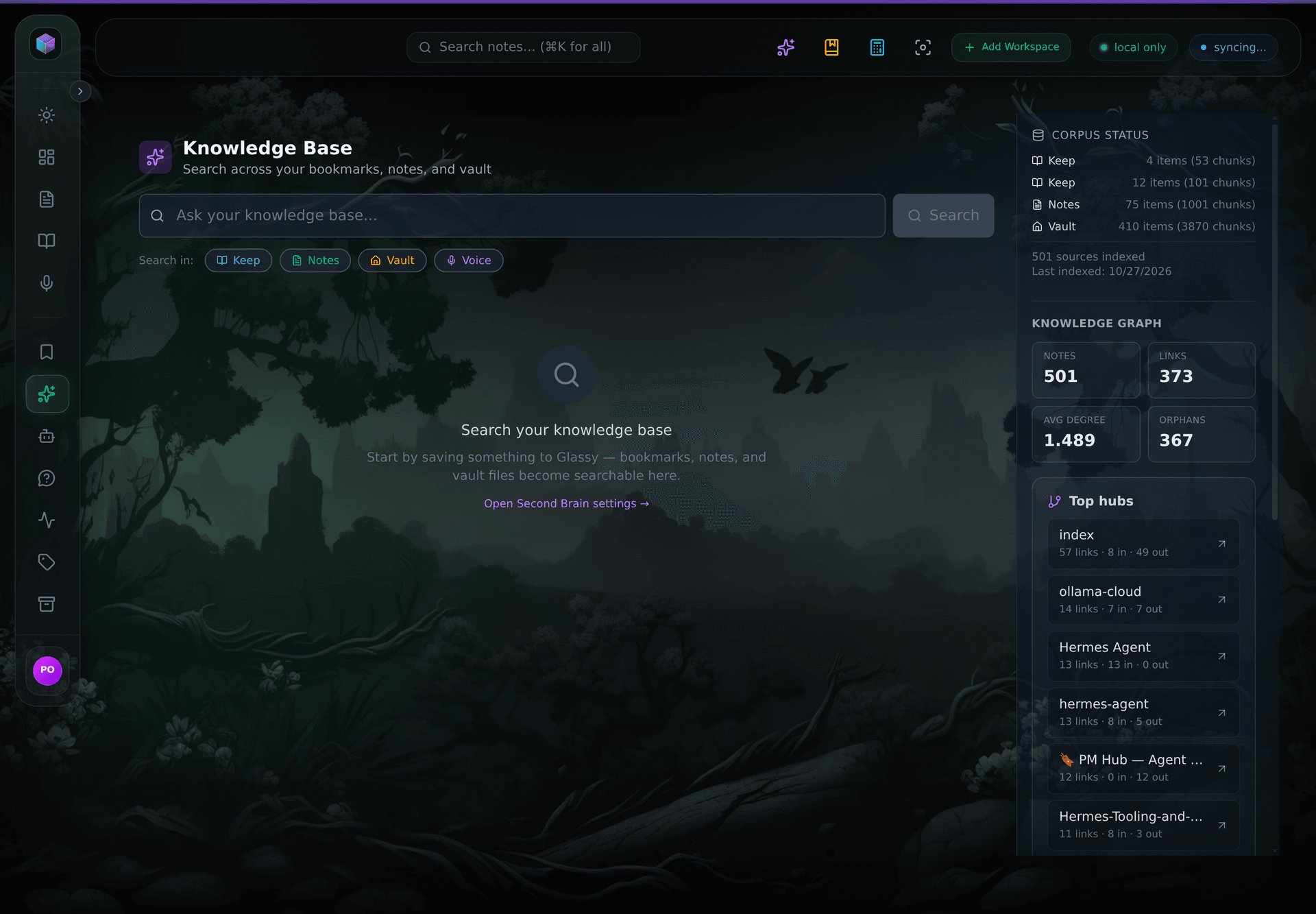
Sources, links, orphan counts, and the hubs your notes actually orbit — visible, countable, and yours to rebuild. Not a black box you have to trust.
501 sources indexed. 373 links. The hubs are named, not ranked by a black box.
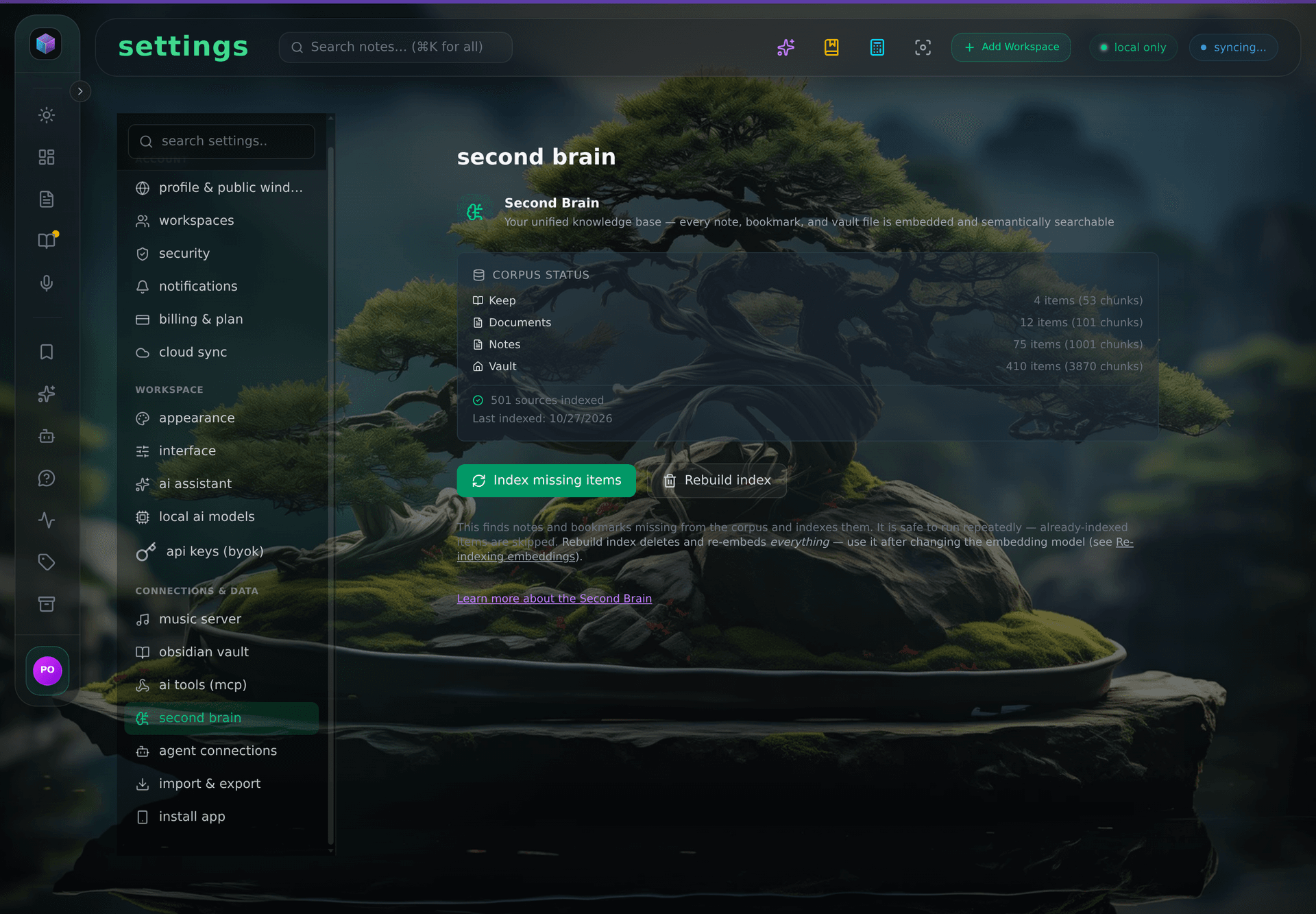
Index, repair, rebuild. The corpus is yours to maintain.
Does this train AI models?
No. Your corpus is never used as training data, and we do not sell it. On your own machine the
corpus does not leave it at all — only the query you send goes to the assistant you chose.
Do I need to be a developer?
No. Generate a key in Settings, copy the config snippet for your client, paste it in. The
snippet carries the live server URL. That is the whole setup.
What if I don't use Obsidian?
Second Brain works with Glassy-native bookmarks, notes and documents alone. Obsidian is an
optional layer, not a requirement.