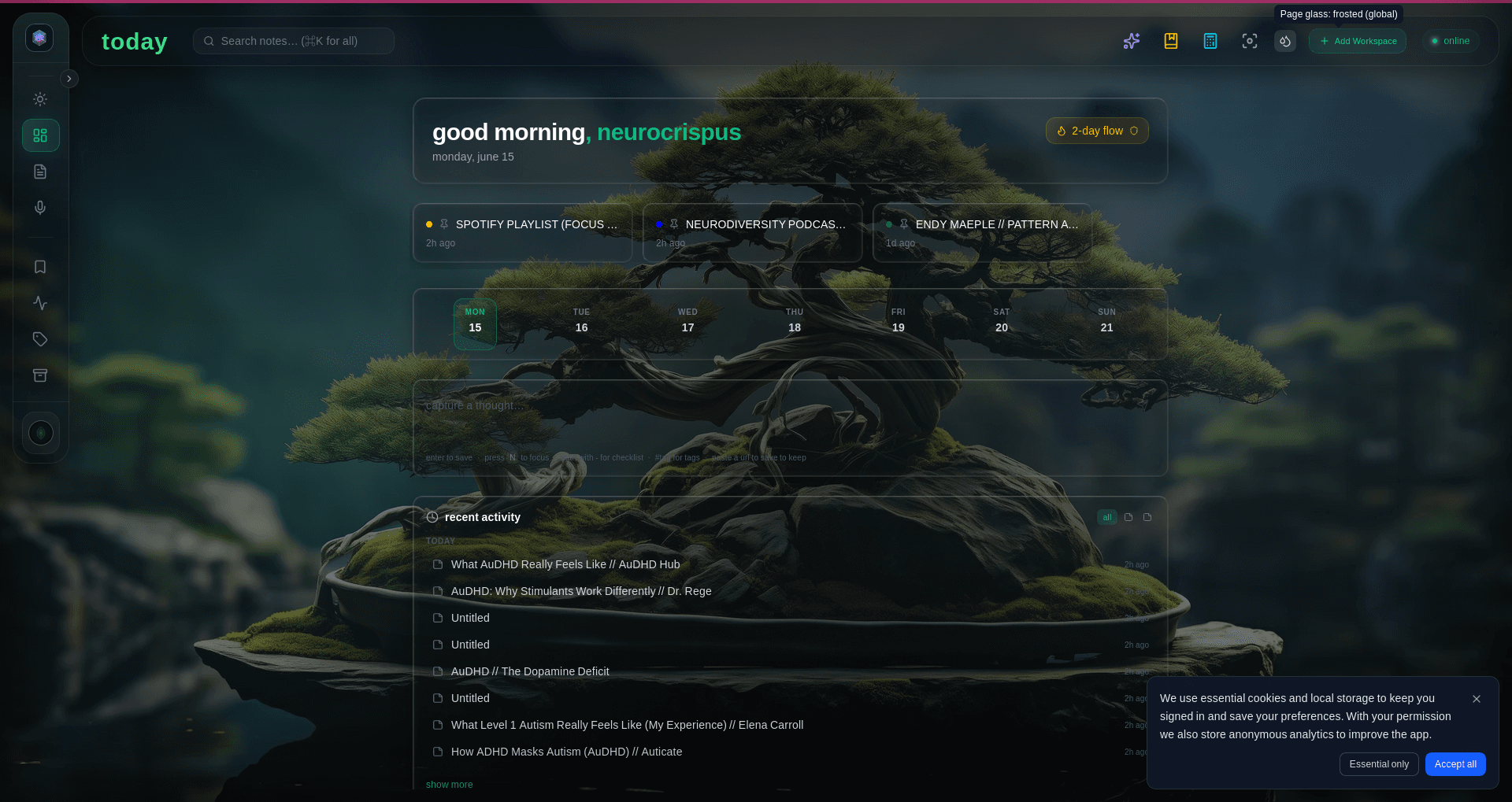
Duolingo has a 2,000-day streak. Snapchat has streaks. Notion has a "days active" counter. Every productivity app worth its Series B has some form of gamified retention mechanic. The logic is simple: if people feel they will lose something by not opening the app, they will open the app.
For neurotypical brains, this works. A streak is a gentle nudge. A broken streak is a minor disappointment that motivates a restart. But for ADHD brains, streaks are not nudges. They are punishment systems.
The ADHD streak cycle
Here is what happens when an ADHD person encounters a streak:
- Hyperfocus phase — The streak is new and exciting. The brain floods with dopamine. They use the app every day for two weeks. The streak counter climbs. Everything feels great.
- Inevitable gap — ADHD is not a consistency disorder, but it is a consistency challenge. One missed day — a bad sleep night, a hyperfocus on a different project, a sensory overload day — and the streak breaks.
- Shame spiral — The broken streak is not a minor disappointment. It is evidence, presented by the app itself, that they failed. The brain that already struggles with executive function now has a concrete artifact of its inadequacy.
- Abandonment — Why start again? The streak is at zero. The app that was supposed to help has become a monument to failure. They delete it.
This is not hypothetical. It is the most common story in every ADHD productivity community. "I loved that app until I lost my streak."
What streaks actually optimize for
Streaks optimize for daily engagement, not for outcomes. A 365-day streak does not mean you learned a language. It means you opened an app 365 days in a row. For a company measuring DAU, that is the metric that matters. For a user trying to build a second brain, it is actively counterproductive — it rewards opening the app over actually thinking.
Knowledge work is not daily. You might capture 20 things on Tuesday and nothing on Wednesday. That is not a failure. That is how nonlinear brains work. A tool that punishes you for not capturing on Wednesday is a tool that misunderstands its own purpose.
What Glassy does instead
Glassy has no streaks. No badges. No "days active" counter. No notification that says "You have not captured anything in 3 days." The app does not track your consistency because your consistency is not our business.
Instead, we optimize for capture ease. The best time to use Glassy is whenever you have something to save. One shortcut, one click, one voice memo. No friction, no preamble, no decision about which folder or tag. The app is ready when your brain is ready, and it is invisible when it is not. Read more about our neurodivergent design philosophy and the broader design principles behind it.
The design principles
These are the rules we follow, derived from our own ADHD experience and from the neurodivergent community:
- No streaks, ever. Not "optional streaks." Not "streaks you can hide." None. The feature is the problem, not the presentation.
- No red badges. Notification counts are neutral gray, not red. Red is a threat signal. A bookmark count is not a threat.
- No nudges or reminders. The app does not send push notifications to "remind" you to use it. You will use it when you need it.
- No leaderboards or social comparison. Your knowledge base is private. There is no one to compare yourself to.
- Reduced motion by default. Animations are opt-in. For brains that process visual motion at higher intensity, a bouncing icon is not delightful — it is exhausting.
- Plain language. No "workspace optimization suite." No "cognitive enhancement framework." Just: notes, bookmarks, search.
The counter-argument
"But streaks help some people." Yes, they do. For some neurodivergent people — particularly those with anxiety-driven consistency — streaks provide structure. We are not arguing that streaks should be banned from all software. We are arguing that they should not be the default, and that tools designed for neurodivergent brains should treat them as an opt-in experiment, not a core mechanic.
Glassy's position is simpler: we do not build them. If you need external consistency pressure, there are dozens of apps that provide it. Glassy is for the brain that needs the opposite — a tool that works when you show up and does not punish you when you do not.
The result
We hear the same thing from users: "This is the first note app I have not abandoned after three weeks." That is not because Glassy is better at retention mechanics. It is because Glassy has no retention mechanics. The app does not try to keep you. It tries to be useful when you arrive.
For nonlinear brains, that is the only design that works.