Security
Last updated: 2026-08-10
Short version
Glassy is built to keep private work boring: secure transport, JWT auth stored in your browser's localStorage, local AI for supported actions, and no model training on your notes. Your Second Brain corpus stays on your server; only the specific query leaves your machine.
Data at rest
Hosted account data lives in the Glassy application environment and follows the retention rules published in our privacy policy. We keep storage claims here tied to the supported release state instead of naming infrastructure that may change.
Data in transit
Connections to Glassy use HTTPS. Production routing sits behind managed TLS, and we keep transport security checks in the deployment checklist before public rollout.
Local AI
Supported AI actions run on your device when your browser and hardware allow it. Those local prompts and context stay local.
Optional cloud AI
If you opt in to a cloud model, the request leaves your device for that action. There is no AI allowance bundled into any plan: you bring your own provider key, or buy a pack of credits once. We keep cloud AI explicit so privacy-sensitive work can stay local.
Second Brain / MCP data flow
Your knowledge base corpus — bookmarks, notes, documents, voice transcripts, and Obsidian vault files — is indexed on the instance you use: your own appliance, or our hosted build where the corpus is operator-run. When you query from Claude Desktop or Cursor via the MCP server, only the search results relevant to your query are returned. Your full corpus is never handed to the client. The MCP server uses DNS-rebinding protection, per-key authentication, and the official @modelcontextprotocol/sdk v2.
Authentication
Auth is a signed JWT stored in localStorage['glassy-dash-token'] on the app.glassy.fyi origin. There is no server-side session cookie. The only cookie Glassy sets is glassy_authed=1 — a first-party presence flag that lets these marketing pages show a signed-in "Open Glassy" button; it carries no credential and no personal data.
Rate limiting as a security control
Tier-based rate limits protect against abuse and keep the shared surfaces available: MCP calls are budgeted at 120 an hour on a free account and 1,200 on a paid one, and Cloud Sync at 2 and 60 cycles an hour. Your own appliance carries no such budgets.
Backups & retention
Account deletion is permanent within 30 days. Encrypted backups are purged on the same schedule.
Disclosure
Report a vulnerability to [email protected]. PGP key on request. We aim to respond within 72 hours and credit reporters in the changelog when they want credit.
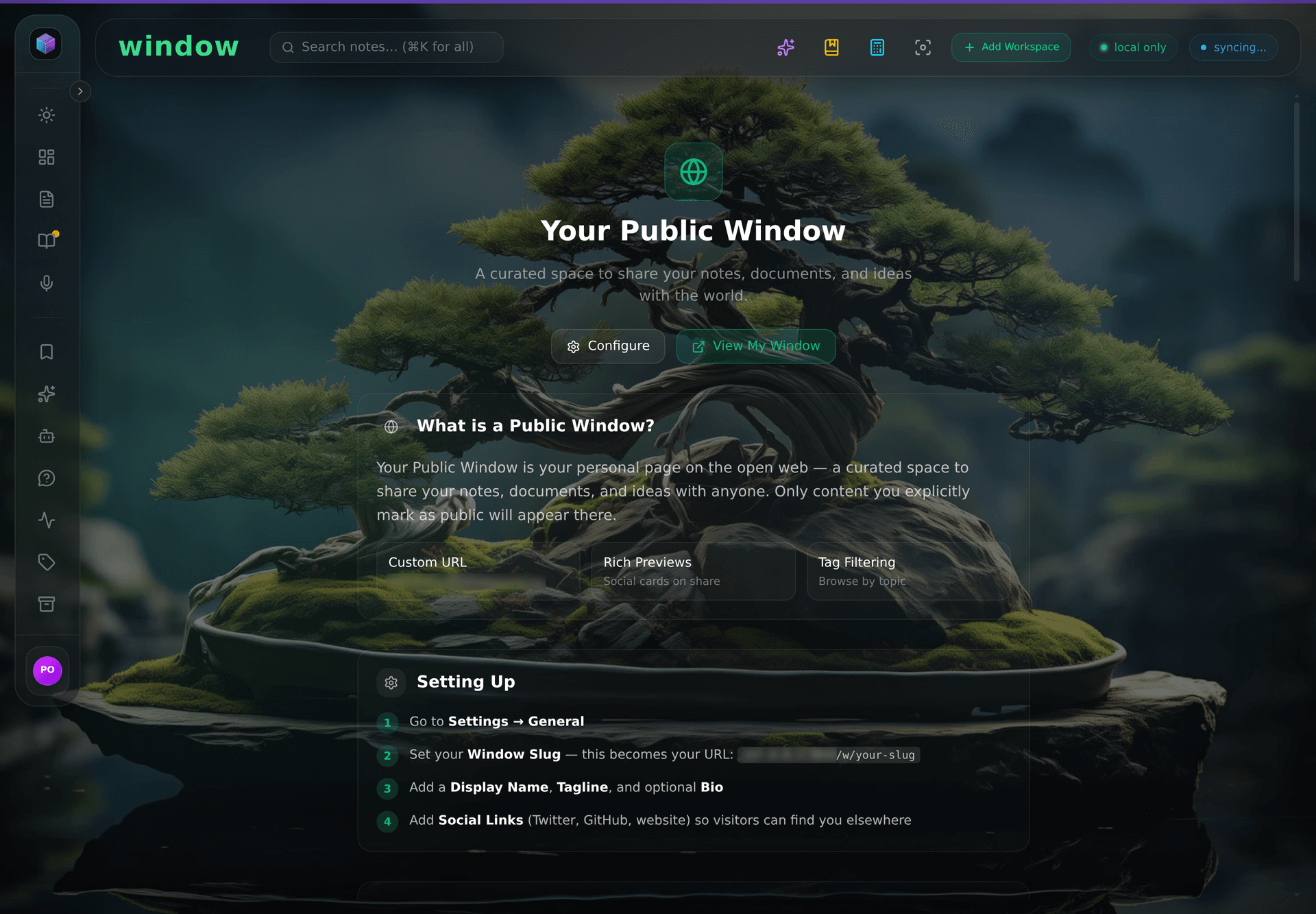
Your Public Window
Public by choice, not by default.
A window is a curated page you choose to publish. The controls are explicit — the custom URL, the previews, the tag filter — and everything you don't publish stays private.