The usual privacy pitch is a policy: "we will not look at your data." Glassy's pitch is structural: there is nowhere for your data to go. The AI runs in your browser. The embeddings are generated on your device. The search index lives in your local storage. There is no server to breach, no cloud vector database to subpoena, no training pipeline to opt out of.
Policy privacy vs structural privacy
Most AI note apps follow the same pattern: your content is uploaded to a server, processed by a cloud model, stored in a vector database, and indexed for search. The company promises not to look at it, not to train on it, and not to share it. You trust the policy.
The problem with policy privacy is that policies change. Companies get acquired. Terms of service get updated. Subpoenas get issued. Databases get breached. The policy is only as strong as the company's current intentions and current security posture.
Structural privacy is different. It is an architecture, not a promise. When AI runs in your browser via WebGPU, there is no server-side model that processes your text. When embeddings are generated locally by mxbai/MiniLM running in WebAssembly, there is no cloud vector database. When the search index lives in IndexedDB, there is no server to breach. You can open DevTools and verify: no network traffic means no data leaving. For the technical background on how this works, see our posts on WebGPU in 2026 and Local AI vs Cloud AI.
What stays on your device
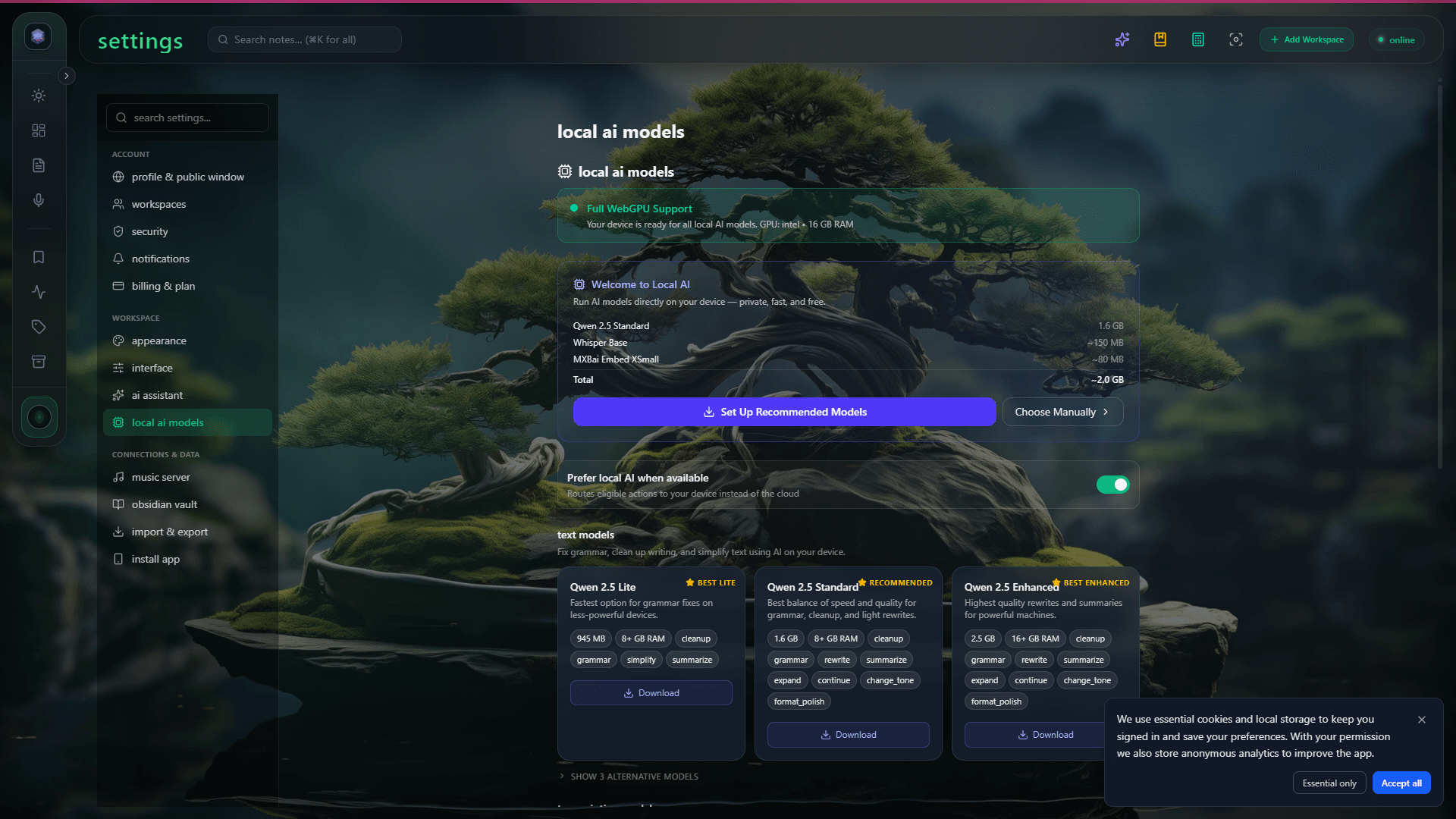
In Glassy, these AI operations run entirely in your browser:
- Text generation (Qwen 2.5) — Summarize, expand, rewrite, auto-tag. The model loads on first use (~500 MB), caches in IndexedDB, and runs on your GPU via WebGPU.
- Speech transcription (Whisper) — Voice Studio records and transcribes audio locally. The audio file and transcription never leave your device.
- Semantic embeddings (mxbai/MiniLM) — 384-dimensional vectors generated in-browser. These power Related Notes and Smart Tag Suggestions.
- Related Notes (kNN) — Cosine similarity computed locally against your IndexedDB vector cache. No server round-trip.
- Smart Tag Suggestions — kNN tag aggregation from your nearest notes. Runs on-device with an "On Device" badge.
What goes to the server (and why)
Glassy is not fully local. Your notes are stored on Glassy's server (or your own Docker host) so you can access them from any device. The MCP server runs server-side so AI agents can query your corpus remotely. Here is the exact boundary:
| Operation | Where it runs | Data leaves device? |
|---|---|---|
| Note storage | Server (SQLite) | Yes — stored encrypted |
| Text generation | Browser (WebGPU) | No |
| Transcription | Browser (WASM) | No |
| Local embeddings | Browser (WebGPU) | No |
| Related Notes | Browser (kNN) | No |
| Hybrid search | Server | Query sent, results returned |
| MCP queries | Server | Query sent, results returned |
| Cloud AI (opt-in) | Server (OpenAI/Anthropic) | Yes — only if explicitly enabled |
The key distinction: the server stores your notes and runs search, but it does not run AI inference on your content. The AI models run in your browser. Cloud AI (GPT-4, Claude) is an explicit opt-in for harder work — it is never the default, and it is never silent.
The self-host option
For users who want zero data on anyone else's server, Glassy Clear runs on your own Docker host. Same image, same features, same MCP server. Your notes, your embeddings, your search index — all on infrastructure you control. No phone-home, no telemetry, no cloud dependency.
This is the strongest form of structural privacy: not even Glassy has your data. The server is yours. The database is yours. The MCP keys are yours. If you shut it down, the data ceases to exist anywhere but on your machine.
Who needs this
Structural privacy is not paranoia. It is a requirement for specific use cases:
- Therapy notes — Content that should never exist on a third-party server
- Medical records — HIPAA requires data residency controls
- Attorney-client work product — Privileged content cannot be processed by third-party AI
- Source code and trade secrets — Corporate IP that cannot leave the firewall
- Journaling — Personal content that is nobody's business but yours
- Research under embargo — Pre-publication academic work
The verification test
You do not need to trust Glassy's privacy policy. You can verify it yourself:
- Open Glassy in your browser
- Open DevTools (F12) → Network tab
- Write a note, run a local AI summarization, generate smart tags
- Watch the Network tab — there will be no requests during AI operations
- The only network traffic is saving the note to the server and loading the page
No traffic means no data leaving. That is a stronger guarantee than any privacy policy can offer.